If knee pain has started affecting the way you walk, climb stairs, sit, sleep, or perform your everyday activities, you may eventually begin searching for a Robotic Knee Replacement Doctor in Nagpur. I understand why. When pain continues despite medicines, physiotherapy, exercise, or lifestyle changes, patients naturally want to know whether knee replacement is the right solution and whether robotic-assisted surgery can make a meaningful difference.
As an orthopaedic doctor, I believe the first step should never be to choose a technology simply because it sounds advanced. The first step is to understand your knee.
Every patient comes with a different history. Some have gradually developed osteoarthritis with age. Some have suffered an earlier injury. Others have severe stiffness, deformity, or pain that has progressively reduced their mobility. Before recommending knee replacement, I look at the condition of the joint, the severity of symptoms, your overall health, your daily activities, and how you have responded to previous treatment.
If knee replacement becomes appropriate, we can then discuss whether robotic assistance is suitable for your particular case.
At Dr. Agrawal's R.K. Hospital, Central Avenue, Nagpur, my approach is to help patients understand their condition clearly so that they can make an informed decision rather than choosing surgery based only on advertisements or technology.
What Is Robotic Knee Replacement?
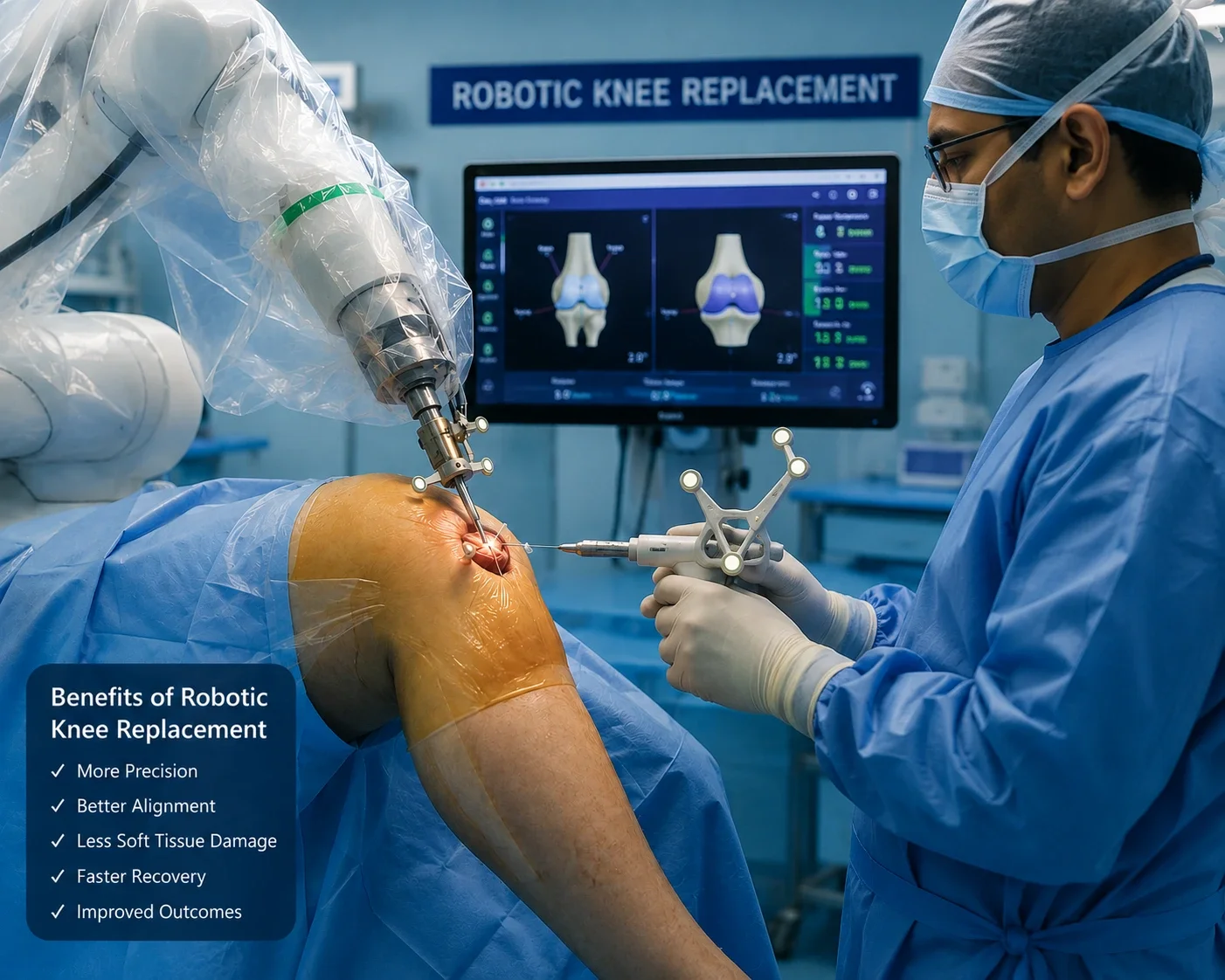
Robotic knee replacement is a knee replacement procedure performed with the assistance of a robotic or computer-assisted surgical system.
One point I always explain to my patients is that the robot does not replace the surgeon.
The surgeon remains responsible for evaluating the patient, planning the procedure, making clinical decisions, preparing the knee, and placing the implant. Robotic technology acts as an advanced surgical tool that can assist with planning and precision.
Depending on the technology being used, information about the patient's knee anatomy can help create a more detailed surgical plan. During the procedure, the system can provide guidance regarding bone preparation and implant positioning.
The purpose is not simply to use a robot because it is available. The purpose is to use technology where it can provide meaningful assistance during the patient's treatment.
This distinction is important because patients sometimes assume that robotic surgery is completely automatic or that it guarantees a particular recovery period. It does not.
Your outcome depends on several factors, including the condition of your knee, your general health, the surgical procedure, implant selection, postoperative care, and rehabilitation.
Why Are Patients Looking for a Robotic Knee Replacement Doctor in Nagpur?
When someone searches for a Robotic Knee Replacement Doctor in Nagpur, there is usually a real problem behind that search.
It may begin with something as simple as discomfort while climbing stairs.
Initially, you may ignore it. You may reduce your walking, use a pain-relieving medicine, apply heat, or assume that the pain will settle. For some people, these measures provide relief for a period of time.
But gradually, the situation may change.
You may begin taking the stairs more slowly. You may use your hands to get up from a chair. A short walk to the market may become uncomfortable. You may stop going for evening walks. Some patients tell me that they have started planning their day around their knee pain.
These changes are important.
Knee arthritis is not only about what an X-ray looks like. I also want to understand what your knee is preventing you from doing.
If pain and stiffness are significantly affecting your quality of life, an orthopaedic evaluation can help determine whether the problem can still be managed without surgery or whether joint replacement should be considered.
When Does Knee Pain Become a Reason to See a Knee Replacement Specialist?
Not every painful knee requires replacement.
This is one of the most important things I tell patients.
Knee pain can occur for many reasons, and the appropriate treatment depends on the cause. In some patients, physiotherapy, activity modification, weight management, medication, injections, or other conservative approaches may provide meaningful relief.
However, I recommend seeking an evaluation when knee pain becomes persistent or starts interfering with normal life.
You may want to consult an orthopaedic specialist if you are experiencing:
- Persistent knee pain while walking
- Pain while climbing or descending stairs
- Difficulty standing for longer periods
- Increasing knee stiffness
- Recurrent swelling
- Difficulty getting up from a chair
- Reduced walking distance
- Pain that interferes with sleep
- Difficulty performing routine household activities
- Increasing dependence on pain medication
- A noticeable change in leg alignment
- Symptoms that continue despite appropriate non-surgical treatment
These symptoms do not automatically mean that you need knee replacement.
They simply indicate that your knee deserves a proper evaluation.
How Do I Decide Whether a Patient Needs Knee Replacement?
When a patient comes to me, I do not make the decision based on an X-ray alone.
I want to understand the complete picture.
I usually consider:
Your Symptoms
I ask where the pain occurs, when it appears, what activities make it worse, and whether it affects your sleep or daily routine.
Your Mobility
I want to know how far you can walk, whether you can climb stairs, whether you require support, and whether your mobility has changed over time.
Previous Treatment
If you have already tried medicines, physiotherapy, exercises, injections, or lifestyle changes, I consider how much relief these treatments provided.
Physical Examination
The movement, stability, alignment, swelling, and overall function of your knee provide important information.
Imaging
Appropriate imaging helps us understand the condition of the joint and the extent of structural damage.
Your Overall Health
Medical conditions, medications, previous surgeries, body weight, fitness, and general health can all be relevant when considering major surgery.
Most importantly, I consider how much the knee problem is affecting your life.
A severely damaged knee on an X-ray does not automatically mean that surgery has to happen immediately if your symptoms are manageable. Conversely, persistent pain and significant functional limitations deserve serious attention.
What Is the Role of Robotic Technology in Knee Replacement?
If knee replacement is appropriate, robotic assistance may help the surgeon plan and perform certain parts of the procedure with greater precision.
One area where robotic-assisted knee replacement has shown advantages is implant alignment and positioning.
A robotic system can provide detailed information and guidance during the procedure, helping the surgeon execute the planned bone preparation and implant positioning.
However, I want patients to understand something very clearly:
Precision is a tool, not a promise.
Robotic assistance does not mean that every patient will have the same recovery or that complications are impossible. It also does not mean that conventional knee replacement is an inferior procedure.
The technology should support good surgical judgement—not replace it.
Robotic Knee Replacement vs Conventional Knee Replacement
Patients frequently ask me:
“Doctor, should I choose robotic knee replacement or traditional knee replacement?”
There is no universal answer.
Conventional knee replacement is a well-established procedure. Robotic-assisted surgery adds technology that can support surgical planning and precision.
Research has shown that robotic assistance can improve the accuracy and consistency of implant alignment. However, better alignment on imaging does not necessarily mean that every patient will experience a dramatic improvement in long-term function compared with conventional surgery.
This is why I do not believe patients should select a procedure simply because the word “robotic” appears in the name.
Instead, ask:
Is this technology appropriate for my knee?
That is the more useful question.
The decision should consider your anatomy, arthritis severity, deformity, previous procedures, overall health, expectations, and the surgeon's assessment.
What Happens During Robotic Knee Replacement?
Understanding the process can make patients feel more prepared.
Step 1: Consultation and Evaluation
We begin by discussing your symptoms and medical history.
I examine your knee and assess your movement, alignment, stability, and functional limitations.
Step 2: Imaging and Planning
Appropriate imaging is used to understand the condition of your knee.
Depending on the robotic system and surgical approach, this information may contribute to computer-assisted planning.
Step 3: Creating the Surgical Plan
The technology can help create a more detailed plan for the procedure.
This allows the surgeon to consider the individual anatomy of your knee rather than treating every knee in exactly the same way.
Step 4: Robotic-Assisted Procedure
During surgery, I use the robotic system as an assistance and guidance tool.
The system provides information that can help with planned bone preparation and implant positioning.
The surgeon remains in control throughout the procedure.
Step 5: Implant Placement
The damaged portions of the joint are prepared, and the appropriate artificial components are positioned.
Step 6: Recovery and Rehabilitation
Surgery is only one part of knee replacement.
Rehabilitation is equally important.
Your physiotherapy program will help restore movement, strength, walking ability, and confidence.
What Benefits Can Robotic Knee Replacement Offer?
The potential benefits of robotic assistance need to be understood realistically.
Individualised Surgical Planning
Robotic technology can help the surgeon plan the procedure according to the patient's specific anatomy.
Greater Alignment Precision
One of the better-established advantages of robotic-assisted knee replacement is improved accuracy of implant alignment in comparison with conventional techniques.
Controlled Bone Preparation
Computer-assisted guidance may help the surgeon perform planned bone preparation with greater precision.
Real-Time Guidance
The technology can provide information during surgery that supports the surgeon's decisions and execution of the surgical plan.
Potential Early Functional Benefits
Some research suggests that certain patients may experience modest early improvements after robotic-assisted surgery. However, outcomes vary, and robotic surgery should not be presented as a guarantee of faster recovery.
I believe patients deserve this balanced explanation.
Technology is valuable, but the right patient selection, surgical planning, execution, and rehabilitation remain essential.
Does Robotic Surgery Mean Faster Recovery?
This is one of the most common misconceptions I encounter.
Robotic assistance may provide greater precision during surgery, but it does not mean that every patient will recover at exactly the same speed.
Recovery can depend on:
- Your age
- Overall health
- Muscle strength before surgery
- Knee stiffness
- Severity of arthritis
- Body weight
- Surgical complexity
- Pain management
- Physiotherapy
- Your ability to follow rehabilitation advice
- Support available at home
Two patients can undergo similar procedures and have very different recovery experiences.
My advice is to focus less on comparing your recovery with somebody else's and more on following a structured rehabilitation plan.
What Is Recovery Like After Knee Replacement?
Patients often ask me, “Doctor, when will I be able to walk normally?”
I explain that recovery happens progressively.
Initially, you may need walking assistance. Physiotherapy generally focuses on controlled movement, strength, mobility, and gradually improving your ability to perform daily activities.
As your strength and confidence improve, your dependence on walking support can reduce.
Your rehabilitation team will guide you regarding appropriate exercises and activity levels.
You should not push through severe pain simply because someone else recovered quickly.
At the same time, avoiding movement completely can also make recovery more difficult.
A balanced, medically guided rehabilitation program is important.
Is Robotic Knee Replacement Safe?
Robotic-assisted knee replacement is an established approach, but it is still major surgery.
No responsible doctor should tell a patient that robotic surgery eliminates surgical risks.
Potential complications associated with knee replacement can include infection, blood clots, bleeding, stiffness, nerve or blood-vessel injury, persistent pain, implant-related problems, or the possibility of additional surgery.
The risk varies from patient to patient.
During consultation, I believe it is important to discuss not only the potential advantages but also the limitations and risks of treatment.
An informed patient is better prepared than a patient who has been promised an unrealistic outcome.
Who May Be a Candidate for Robotic Knee Replacement?
Robotic-assisted knee replacement may be considered for patients who require knee replacement and are appropriate candidates for the particular robotic system and surgical approach.
However, the availability of robotic technology does not mean that every patient requires it.
A patient's suitability may depend on:
- Extent of joint damage
- Type of arthritis
- Knee alignment
- Joint deformity
- Previous knee surgery
- Overall medical condition
- Bone quality
- Patient expectations
- Surgical assessment
This is why I recommend an individual consultation rather than deciding based solely on an online article or advertisement.
How Should You Choose a Robotic Knee Replacement Doctor in Nagpur?
If you are searching for a Robotic Knee Replacement Doctor in Nagpur, I recommend looking beyond the technology.
Ask yourself whether the doctor:
Understands Your Problem
The doctor should first understand why you are experiencing pain and how the condition is affecting your life.
Explains All Treatment Options
A good consultation should not automatically end with surgery.
You should understand whether non-surgical treatment remains reasonable and why replacement is or is not being considered.
Has Relevant Orthopaedic Experience
Knee replacement requires appropriate orthopaedic expertise. Ask about the surgeon's qualifications, training, and experience with joint replacement procedures.
Understands Robotic Technology
If robotic surgery is being considered, ask which system is used, how it assists the procedure, and why it may be appropriate for your case.
Provides Realistic Expectations
Be cautious of promises such as guaranteed pain-free results, guaranteed rapid recovery, or guaranteed outcomes.
No surgery should be presented as risk-free.
Provides Postoperative Support
Your treatment does not end when you leave the operating room.
Physiotherapy, follow-up appointments, wound care, medication management, and gradual return to activity are important parts of recovery.
Questions You Should Ask Your Robotic Knee Replacement Doctor
I encourage patients to ask questions rather than feeling hesitant during a consultation.
You can ask:
- Do I actually need knee replacement?
- Could non-surgical treatment still help me?
- Am I a suitable candidate for robotic-assisted surgery?
- Why would robotic assistance be useful in my particular case?
- Which robotic technology will be used?
- What type of knee replacement is appropriate for me?
- What are the potential risks and complications?
- How should I prepare for surgery?
- What will rehabilitation involve?
- When can I realistically return to my normal activities?
- What follow-up care will I need?
- What should I do if I experience a problem during recovery?
A good doctor-patient relationship should allow you to ask these questions comfortably.
Why Choosing Treatment in Nagpur Can Be Practical
For patients living in Nagpur and nearby areas, receiving treatment locally can make the overall journey more convenient.
Knee replacement is not limited to one day in the operating room.
You may require:
Consultation → Investigations → Preoperative preparation → Surgery → Hospital care → Physiotherapy → Follow-up
Having access to your treating team in the same city can make follow-up and rehabilitation more manageable.
At Dr. Agrawal's R.K. Hospital, located at Central Avenue, Chandrashekhar Azad Square, beside Hotel Al Zam Zam, Ladpura, Itwari, Nagpur, patients can discuss their knee condition and treatment options with the orthopaedic team.
What Should You Do Before Considering Robotic Knee Replacement?
Before deciding on surgery, I recommend focusing on preparation rather than simply thinking about the operation.
During your consultation, keep a record of:
- How long you have had knee pain
- Which activities cause pain
- Previous treatments you have tried
- Medicines you currently take
- Previous surgeries or injuries
- Other medical conditions
- Any previous knee imaging
- Your main concerns about surgery
- The activities you want to return to
If you have previous medical reports or X-rays, bring them to your appointment.
Most importantly, be honest about your expectations.
If your goal is to walk comfortably, climb stairs, return to work, or resume a particular activity, tell your doctor. Understanding your goals helps make the discussion more meaningful.
My Advice to Patients Considering Robotic Knee Replacement
If you are currently struggling with knee pain, my advice is simple:
Do not make your decision based on the word “robotic” alone.
First understand your diagnosis.
Then understand the available treatment options.
If knee replacement is necessary, discuss whether robotic assistance can provide a meaningful advantage in your particular case.
Ask about the surgeon's experience, the hospital setup, the implant, rehabilitation, potential risks, and realistic expectations.
I also encourage patients not to wait until their mobility has reduced dramatically before seeking an evaluation.
A consultation does not commit you to surgery.
It gives you an opportunity to understand what is happening inside your knee and what options may be available.
Frequently Asked Questions
What is a robotic knee replacement doctor in Nagpur?
A robotic knee replacement doctor in Nagpur is an appropriately qualified orthopaedic surgeon who performs knee replacement procedures with the assistance of robotic or computer-assisted technology when appropriate for the patient.
Is robotic knee replacement completely performed by a robot?
No. The surgeon remains responsible for clinical decisions and the surgical procedure. Robotic technology assists the surgeon with planning, guidance, and precision.
Is robotic knee replacement better than traditional knee replacement?
Robotic assistance can improve the accuracy of implant alignment, but it is not appropriate to say that robotic surgery is universally better for every patient. The right procedure depends on individual clinical circumstances.
Does robotic knee replacement guarantee faster recovery?
No. Recovery varies between patients. Rehabilitation, overall health, muscle strength, knee condition, and other factors influence recovery.
Who needs knee replacement?
Knee replacement may be considered for patients with significant joint damage and persistent symptoms that substantially affect daily activities, particularly when appropriate non-surgical treatments have not provided sufficient relief.
Can I avoid knee replacement?
Depending on the cause and severity of your knee condition, non-surgical treatments may help. A proper orthopaedic evaluation is necessary before deciding that replacement is required.
Is robotic knee replacement safe?
Robotic-assisted knee replacement is an established surgical approach, but it carries potential risks like other major surgeries. Your individual risks should be discussed with your surgeon.
How long does knee replacement recovery take?
Recovery varies. Early movement and rehabilitation are important, but the time required to regain strength and return to different activities depends on the individual patient.
What should I ask a robotic knee replacement doctor?
Ask whether replacement is necessary, whether alternatives remain available, whether robotic assistance is appropriate, what risks are involved, what implant will be used, and what rehabilitation and follow-up will be required.
Where can I consult for robotic knee replacement in Nagpur?
Patients looking for consultation can contact Dr. Agrawal's R.K. Hospital at Central Avenue, 27, Chandrashekhar Azad Square, beside Hotel Al Zam Zam, Ladpura, Itwari, Nagpur, Maharashtra 440002, for an orthopaedic evaluation and discussion of suitable treatment options.
Conclusion
If you are searching for a Robotic Knee Replacement Doctor in Nagpur, I encourage you to look at the decision from a patient's perspective rather than simply focusing on technology.
The most important question is not:
“Does this hospital have robotic surgery?”
It is:
“Is knee replacement the right treatment for my condition, and if it is, can robotic assistance provide meaningful value in my particular case?”
Robotic technology can assist with surgical planning and precision, particularly implant alignment and bone preparation. But technology is only one part of successful knee replacement.
The experience and judgement of the orthopaedic surgeon, careful patient selection, appropriate implant choice, safe surgical practice, postoperative care, and committed rehabilitation all matter.
My role as an orthopaedic doctor is not simply to recommend a procedure. It is to understand your problem, explain your options, answer your questions, and help you make a decision based on your individual condition.
If persistent knee pain is affecting your walking, sleep, stairs, work, or independence, do not ignore it.
A consultation can help you understand what is happening inside your knee and whether treatment—conservative or surgical—is appropriate for you.